
|
Thursday, 19 November 2015
Build Your Business From The Comfort Of Your Home

MESSAGE TO THE BLACKMAN - by Elijah Muhammad

As we near the exhaustion of the Wisdom of
this world which has not been able to shed enough light on our path in search for that
Supreme Wisdom to keep us from stumbling and falling, we now seek the wisdom of Allah, the
Best Knower and Guide in the Person of Master Fard Muhammad (to Whom be praised
forever). The reader will find that light in this book.
-Honorable Elijah Muhammad, Messenger of
Allah

Section one
: Allah is God

Section Two
: Original Man
Search Message to the
Blackman
| Home | Temple | Univ. of Islam | Wellness Center | Trade Center | Intentional Community | | Municipal Complex | Events Center | Contact Us | Search | Chat Room | Message Board | Newsletter | Directory | |
| If
you experience any problems or have questions concerning this site, Email: Webmaster@seventhfam.com copyright, 1997, 1998, 1999, Nation Of Islam Settlement No. 1 |
Wednesday, 18 November 2015
Lebo M, And 'The Lion King"
NEWS
SA Grammy Award Winner Lebo M, An Inspiration

By Thandisizwe Mgudlwa
America continues to gloat over it’s high achiever many decades later. And this works big time in promoting and developing the country as global brand. South Africa must do the same. Here is another example of great success story from South Africa.
Lebohang “Lebo M.” Morake became involved in music at the tender age of nine as a singer of American R&B and rock standards in his neighborhood’s pop band.
Archives reveal that he was only 12 when his first single was released. ‘Celebration’ was issued by EMI South Africa, although he only received remuneration of $20 despite its local success.
Angered and frustrated by the corruption endemic in the apartheid South African music business, he transported himself to neighboring Lesotho, becoming house singer at the Victoria Hotel there. Among the many guests he entertained during his stay was US ambassador Tim Thashane, who invited him to relocate to America and undertake a scholarship at the Duke Ellington School of Music in Washington.
He later attended Los Angeles Community College and performed at talent nights at the Memory Lane nightclub, run by actress Maria Gibbs.
Lebo M. was subsequently introduced to composer Hans Zimmer, then working on The Power Of One. Lebo eventually co-wrote, arranged and produced the soundtrack album accompanying the movie.
This led to further commissions, as Lebo added authentic African percussion and township rhythms to movies including Congo, Outbreak, Made In America and Born To Be Wild.
Eventually Zimmer asked him to contribute to The Lion King, the globally successful Walt Disney animation feature. The Zimmer/Lebo composition ‘The Circle Of Life’ subsequently won them a 1995 Grammy for best instrumental arrangement with accompanying vocal.
Lebo then scored the Broadway stage version of The Lion King, which he has described as his most challenging experience so far. Forced to compose new pieces and chants for the production, he amalgamated the resulting compositions into his debut album for Walt Disney Records, released in 1996.
It was quickly followed by a second album for South African label Gallo International. Deeper Meaning revealed a more eclectic side to the artist, incorporating hip-hop, R&B, lush orchestration and traditional African flourishes.
He then worked alongside Quincy Jones on the charity tribute album released to coincide with Nelson Mandela’s 80th birthday.
Lebo M was born on 20 May 1964 in the Apartheid-ridden Soweto in Johannesburg, South Africa and was inspired by Nelson Mandela, he spent years working hard in the slums and then in Los Angeles in a variety of jobs, including begging and serving at McDonald’s. He is also reported to have been exiled from South Africa in 1979, but returned 20 years later.
He lives with his family in Johannesburg and Los Angeles. He founded the Lebo M Foundation and Till Dawn Entertainment. Lebo M has composed, arranged, performed and produced music for the following films: The Lion King (soundtrack), The Lion King II: Simba’s Pride, The Lion King 1½, The Lion King (musical) – singer at One by One, Black Hawk Down, The Power of One, Dinosaur, Disney’s Animal Kingdom: The First Adventure, Tears of the Sun, Back on the Block, The Color Purple, Listen Up: The Life of Quincy Jones, Outbreak, Made In America, Congo, Born to Be Wild (1995 film) and Long Night’s Journey Into Day. His discography includes How Wonderful We Are (1995), Rhythm Of The Pride Lands (1995), and Return to Pride Rock: Songs Inspired by Disney’s The Lion King II: Simba’s Pride (1998)
SOURCE: The African Journalist
Copyright 2015 African Journalist

Tuesday, 17 November 2015
Mahotella Queens, 50 Years On
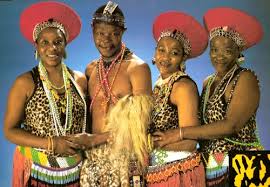
The Mahotella Queens is a South African female group formed in 1964/5.
They were born through the initiative of Rupert Bopape, a music producer.
Originally a studio recording group consisting of around five or six singers, the group is noted for their distinct vocal harmony sound, guitar-led mbaqanga music and fast-paced stage dancing.
Bopape was a talent scout and producer at the independent Gallo Africa's then-subsidiary dedicated to black music, Mavuthela Music Company.
Bopape then formed the Mahotella Queens as the company's resident girl group and the ensemble, often led by the deep-voiced male vocals of Simon 'Mahlathini' Nkabinde, went on to have many hit records during the 1960s.
The current line-up of the Queens comprises Hilda Tloubatla, Nobesuthu Mbadu and Amanda Nkosi.
Mahlathini and the Mahotella Queens, otherwise known as Mahlathini Nezintombi Zomgqashiyo – Mahlathini and the Girls of Mgqashiyo has made its mark as a South African mbaqanga supergroup.
Although the late Simon ‘Mahlathini’ Nkabinde (1937–1999), a phenomenal singer in the basso-profundo ‘groaning’ style is no more, the bit is still great.
Mahlathini, the Queens and the Makgona Tsohle Band had become famous as individual artists, but had frequently recorded together since 1964.
It was only in 1986, when the demand for South African music arose through Paul Simon’s Graceland album, that Gallo Record Company (the three artists’ label) paired them together permanently, as the music archives report.
Mahlathini was known as the “Lion of Soweto” (his voice was a low, “gravel-like” groan) and was well known throughout South Africa and neighboring countries such as Zimbabwe, Botswana , Swaziland and others, during his career.
According to the music library, Mahlathini began singing in the 1950s, often working in conjunction with top producer Rupert Bopape at EMI South Africa, and often performing with the girl group the Dark City Sisters. When Bopape moved to Gallo Record Company in 1964 to start up the new African subsidiary, Mavuthela Music, he brought Mahlathini with him. The bass vocalist’s career then took off. He was backed by Bopape’s newly-formed Makgona Tsohle Band (soon to become the hardest-working mbaqanga session team in the country, led by the country’s electric guitar pioneer Marks Mankwane as well as saxophone star West Nkosi) and often recorded with Bopape’s newly-formed (and highly-successful) Mahotella Queens.
Mahotella Queens was initially a group of five female vocalists established at the Mavuthela division in 1964 by Bopape, who introduced Hilda Tloubatla to sing the main lead vocals.
The Queens began recording hit singles and albums with their backing, the Makgona Tsohle Band, and were often fronted by Mahlathini. In 1971, Mahlathini signed with rival company EMI, and the original Queens all ended up joining rival girl groups. Bopape formed a new Mahotella Queens line-up, who most notably recorded the 1977 album Izibani Zomgqashiyo with Robert “Mbazo” Mkhize (in the place of Mahlathini).
In 1983, the original five Queens (Hilda Tloubatla, Nobesuthu Mbadu, Mildred Mangxola, Juliet Mazamisa and Ethel Mngomezulu) reunited with Mahlathini and the Makgona Tsohle Band with the comeback release Amaqhawe Omgqashiyo (Heroes of Mgqashiyo Music).
“After one more hiatus, three of the Queens (Hilda Tloubatla, Nobesuthu Mbadu and Mildred Mangxola) regrouped full-time in 1986.”
Bopape was a talent scout and producer at the independent Gallo Africa’s then-subsidiary dedicated to black music, Mavuthela Music Company. He formed the Mahotella Queens as the company’s resident girl group and the ensemble, often led by the deep-voiced male vocals of Simon ‘Mahlathini’ Nkabinde, went on to have many hit records during the 1960s.
The Queens and Mahlathini were backed by Mavuthela’s house band, the Makgona Tsohle Band (comprising several talented instrumentalists including Marks Mankwane on lead guitar and West Nkosi on alto saxophone).
And in 1972 the line-up of the Mahotella Queens disintegrated after royalty disagreements with Bopape; Mahlathini left the company in a similar dispute with the producer.
However, with a change of membership, the Queens remained productive and popular into the 1970s and 1980s. In 1987, following the explosion of interest in South African music, the Queens line-up was rejigged and three of its original singers – Hilda Tloubatla, Nobesuthu Mbadu and Mildred Mangxola – returned to the group. In combination with Mahlathini, the group forged a successful international touring career that lasts to this day.
In spite of the deaths of Mahlathini, Marks Mankwane and West Nkosi during the late 1990s, the Mahotella Queens continue to perform and record in the 21st century. In 2013, long-serving member Mildred Mangxola retired from the group following health troubles. She was replaced by a new recruit, Amanda Nkosi.
Initially, Rupert Bopape formed a team of female singers that would record songs under various group pseudonyms. Some of the most successful early recordings had been issued with the same name, Mahotella Queens, and it was this name that became the most recognisable to listeners.
The line-up of the group would consist of five singers taken from a larger pool of vocalists that included Hilda Tloubatla, Juliet Mazamisa, Ethel and Francisca Mngomezulu, Mildred Mangxola, Nobesuthu Mbadu, Windy Sibeko, Mary Rabotapi (formerly of The Skylarks) and Nunu Maseko.
“The music produced by the combination of Mahlathini, the Mahotella Queens and the Makgona Tsohle Band developed heavily on the familiar mbaqanga sound, a type of jive music that fused traditional and modern elements together and played on electric instrumentation.”
“Their take on this music evolved into a unique style referred to as ‘mgqashiyo’, featuring up-tempo female harmony combined with powerful male bass vocal.”

The group would have hit singles throughout the 1960s including “Thoko”, “Sithunyiwe”, “Pitsa Tse Kgolo”, “Ngikhala Ngiyabaleka” and “Izulu Liyaduduma”.
Furthermore, some of their most successful singles were compiled onto albums such as Meet the Mahotella Queens (their first LP), Indoda Mahlathini, Marena, Marks Umthakathi and Umculo Kawupheli.
In 1972, Mahlathini and several of the Queens members departed the group following royalty disputes with Rupert Bopape. Many of the members joined rival groups such as Izintombi Zesi Manje manje.
Mahlathini moved to another record company where he recorded with a new group of vocalists, titled simply The Queens, and backed by a new instrumental band. Bopape worked with the members of the Makgona Tsohle Band to replace the members of the Mahotella Queens who had departed.
The newer line-up consisted of Emily Zwane, Beatrice Ngcobo, Thandi Radebe, Thandi Nkosi and Caroline Kapentar. In 1972, West Nkosi was promoted by Bopape to a producing role. One of his early productions was a then-unknown choir, Ladysmith Black Mambazo.
The Mahotella Queens continued to record and perform successfully throughout the 1970s, on many occasions in combination with groaner Robert ‘Mbazo’ Mkhize, who was also the lead vocalist of Mavuthela’s successful male group Abafana Baseqhudeni.
Guitarist Marks Mankwane became the producer of the Queens following the retirement of Rupert Bopape in the late 1970s. The group’s material included albums like Izibani Zomgqashiyo, Tsamaya Moratuoa, Thatha Izimpahla Zakho, Ezesimanje and Tsa Lebowa.
During the 1980s, the Queens’ popularity dipped as a result of changing musical tastes, and mbaqanga was eventually usurped as the favoured music of the townships by styles such as soul and disco.
Earlier in 1983, Mankwane had reunited Mahlathini with five of the original Mahotella Queens for a spin-off group titled Mahlathini Nezintombi Zomgqashiyo.
However, the decline of mbaqanga music meant that the project lasted only a year. Mankwane continued to produce the Mahotella Queens while Mahlathini decided to join forces with the West Nkosi-produced trio Amaswazi Emvelo, one of the only mbaqanga groups to remain well-selling and popular.
During the mid-1980s, a stream of Western musical projects involving the music of South Africa helped to reestablish the original line-up of the Mahotella Queens in combination with Mahlathini. These included the seminal compilation The Indestructible Beat of Soweto and Paul Simon’s Graceland album.
And in 1987, West Nkosi convinced Mankwane to bring the Queens under his production, and the line-up was completely reformed: the then-membership of the Queens was replaced by three singers associated with the group during its original 1960s heyday – Hilda Tloubatla, Nobesuthu Mbadu and Mildred Mangxola. Together with Mahlathini and most of the original Makgona Tsohle Band, the Queens recorded their first album aimed at the international audience, Thokozile.
It was successful enough to attract overseas promoters and the group – now billed as Mahlathini and the Mahotella Queens – subsequently began a long international touring career, with a successful debut performance in France at the Angouleme Festival.
In 1988, the group performed at the tribute concert held in recognition of Nelson Mandela’s 70th birthday at London’s Wembley Stadium.
Mahlathini and the Mahotella Queens continued to record successful albums including Paris – Soweto, Mbaqanga, Rhythm and Art, Stoki Stoki and Umuntu.
In 1991, producer West Nkosi left the group to continue producing music for the South African audience. Marks Mankwane returned to producing Mahlathini and the Mahotella Queens, as well as continuing to play lead guitar for the group.
Due to health problems stemming from a long-standing diabetic condition, Mahlathini gave his last performance with the Mahotella Queens in 1997.
The year after, former producer West Nkosi was killed in a car crash. On the day of his funeral, guitarist and producer Marks Mankwane died due to complications with sugar diabetes. Mahlathini and the Mahotella Queens decided to continue in tribute to their deceased band members, recording the album Umuntu in early 1999. During the production of the album, Mahlathini’s health deteriorated further. He died in July 1999 following several months of ill health.
After a period of mourning, the Mahotella Queens decided to return to the music industry. They recorded a new album in 2000 titled Sebai Bai, a successful release praised by the international audience and dedicated to Mahlathini, Mankwane and Nkosi. Some of the musicians joining the Queens on the new album included Victor Mkhize on lead guitar, Madoda Ntshingila on bass and Regis Gizavo on accordion. The Queens also continued to tour, with performances in the United States through 2002 and 2003.
And in 2004, the group released an experimental album aimed at a younger audience, Bazobuya, fusing their familiar mgqashiyo sound with modern beats.
In 2005, the Queens released Reign & Shine, another album that departed from their usual sound, featuring a cappella performances backed by traditional percussionist Veli Shabangu and sporadic guitar from their backing band. Accompanied by Shabangu, the group toured the United Kingdom as the support act for Ladysmith Black Mambazo between May and June 2006.
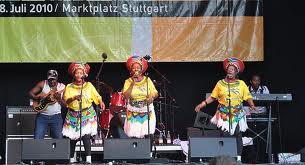
In combination with their complete backing band, the Queens also headlined WOMAD 2006 in July.
In 2007, the Mahotella Queens released a gospel album titled Siyadumisa. The recording featured modern versions of traditional Zulu hymns. The group completed a tour of Europe on 25 August 2007 in which they performed their new material at various WOMAD festivals.
The Queens also performed at venues in South Africa during late 2007 and 2008.
The Queens also performed at venues in South Africa during late 2007 and 2008.
The Queens also appeared as part of Pee Wee Ellis’s show Still Black, Still Proud: An African Tribute to James Brown during 2010. South African jazz artist Hugh Masekela joined forces with the Mahotella Queens for a special UK tour for November 2010. Their performance in London’s Southbank Centre was completely sold out.
In 2013, the Mahotella Queens took part in a competition to find the theme song for the MTN 8 football tournament which is an annual event in South Africa. They recorded a modern version of one of their most well-known hits, “Gazette/Kazet”, accompanied by male singer Zamo and Kwaito star Brickz.
The Queens remained with Gallo until 2005 when they joined an independent company led by former Gallo director Antos Stella.
Photo Credit: Wikipedia.org

Subscribe to:
Posts (Atom)